
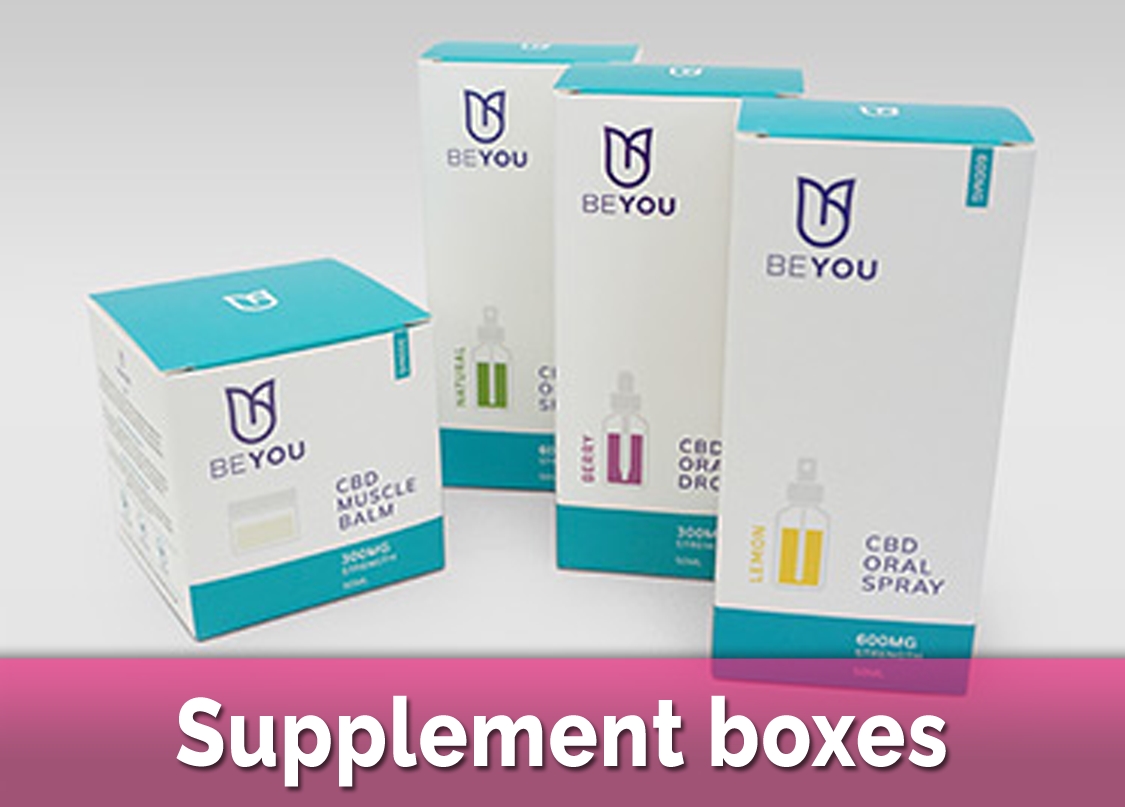
If you are launching a vitamin, mineral or botanical supplement, the box is where most of your legal wording lives. Get it wrong and you could be left with a print run you cannot sell. Get it right and the same carton does your selling for you.
We print supplement packaging for UK brands, and the same questions come up at the artwork stage every time. This guide to supplement packaging rules pulls the answers together in one place: what has to be on the pack, what you cannot say, how small the text can go, and how to fit it all on a carton without making it look like a legal notice.
A quick note before we start: this is a printer’s guide, not legal advice. Rules for food supplements in England sit in the Food Supplements (England) Regulations 2003, and Scotland, Wales and Northern Ireland have their own versions. Always check final wording with a regulatory adviser or your local Trading Standards.
What counts as a food supplement?
In UK law, a food supplement is a concentrated source of nutrients or other substances with a nutritional or physiological effect, sold in measured doses. Think capsules, tablets, gummies, powders in sachets and drops in a bottle. If your product fits that description, it is regulated as a food, not a medicine, and the supplement labelling rules apply.
The wording every UK supplement pack must carry
The supplement regulations add their own list on top of the general food labelling rules. Your pack needs:
- The name “food supplement”. Not “dietary supplement” or “nutritional supplement”.
- The names of the categories of nutrients or substances in the product, such as “vitamins” or “botanical extracts”.
- The recommended daily dose.
- A warning not to exceed the stated recommended daily dose.
- A statement that food supplements should not be used as a substitute for a varied diet.
- A statement that the product should be stored out of the reach of young children.
- The amount of each vitamin, mineral or other substance per daily dose, written as a number with its unit. Vitamins and minerals can also be shown as a percentage of the reference intake, which is the familiar %NRV column.
The general food rules then add the items you would expect on any food: a full ingredients list with allergens emphasised, the net quantity, a best-before or use-by date, a batch number, and the name and address of the business selling the product.
One detail catches people out. The rules say this information must be on the packaging, on a label attached to it, or on a label you can clearly see through the packaging. If your tub is fully labelled but sits inside a closed carton, the shopper cannot see that label, so the carton needs to carry the information too.
What you cannot say on the box
Supplements are foods, so the pack cannot claim or imply that the product prevents, treats or cures any disease. Words like “cures”, “heals” or “fights infection” have no place on a supplement carton.
Health claims such as “vitamin C contributes to the normal function of the immune system” are allowed, but only if they appear on the official GB register of authorised claims and your product contains enough of the nutrient to back them up. The rules also stop you suggesting that a balanced diet cannot give people the nutrients they need. “Because food alone isn’t enough” is a line to avoid.
How small can the text be?
Food labelling law sets a minimum size for mandatory information. The x-height of the font, which is the height of a lower-case “x”, must be at least 1.2 mm. If the largest surface of the pack is under 80 cm², the minimum drops to 0.9 mm.
On screen, 1.2 mm looks generous. On a printed carton it is small, and it gets harder to read if it is printed in a pale colour, reversed out of a dark background, or set over foil. When we check artwork, small text is the first thing we look at.
Fitting it all on the box: tips from our print floor
A standard supplement carton has four main panels plus a top and bottom. That is more room than most brands realise, as long as you plan it before the designer starts.
- Give each panel a job. Front: brand, product name, “food supplement” and capsule count. Back: directions, dose and warnings. Sides: the nutrient table and ingredients.
- Get the cutter guide first. Ask your printer for the dieline before artwork starts, so your designer works to real panel sizes rather than guessing.
- Keep small text away from folds. Text that runs over a crease or onto the glue flap can crack or disappear. Leave at least 3 mm between small text and any fold or cut edge.
- Watch your contrast. Dark text on a light background is easiest to read. Keep mandatory wording off foil, embossing and busy images.
- Plan where codes go. If you print batch numbers and best-before dates on your own filling line, ask your printer to keep a coding area free of varnish or lamination so the ink dries and stays put.
- Add a leaflet. A folded leaflet inside the box gives you space for brand story and usage tips, freeing up the outside for what the law requires.
A pre-print checklist
- “Food supplement” appears in the product name
- Daily dose, the do-not-exceed warning, the varied diet statement and the young children statement are all present
- Nutrient amounts per daily dose, with units and %NRV where relevant
- Ingredients with allergens emphasised, net quantity, date, batch and business address
- Every health claim checked against the GB register
- All mandatory text at least 1.2 mm x-height, and clear of folds and foil
- Final wording signed off by your regulatory adviser
Getting your supplement boxes printed
We make supplement packaging boxes at our factory in Guildford, from short digital runs for new brands to larger litho runs for established ranges. Most of our supplement cartons are printed on folding box board, which is light, stiff and holds sharp colour, and we also print packaging sleeves for brands that want to dress up a plain tub or pouch.
Whatever you are launching, we send a cutter guide, check your artwork for small text and fold problems, and proof everything before it goes to press. If you are planning custom supplement boxes for a new product, get in touch and tell us about your containers and quantities.
Sources: Food supplements guidance, GOV.UK and The Food Supplements (England) Regulations 2003, regulation 6.